

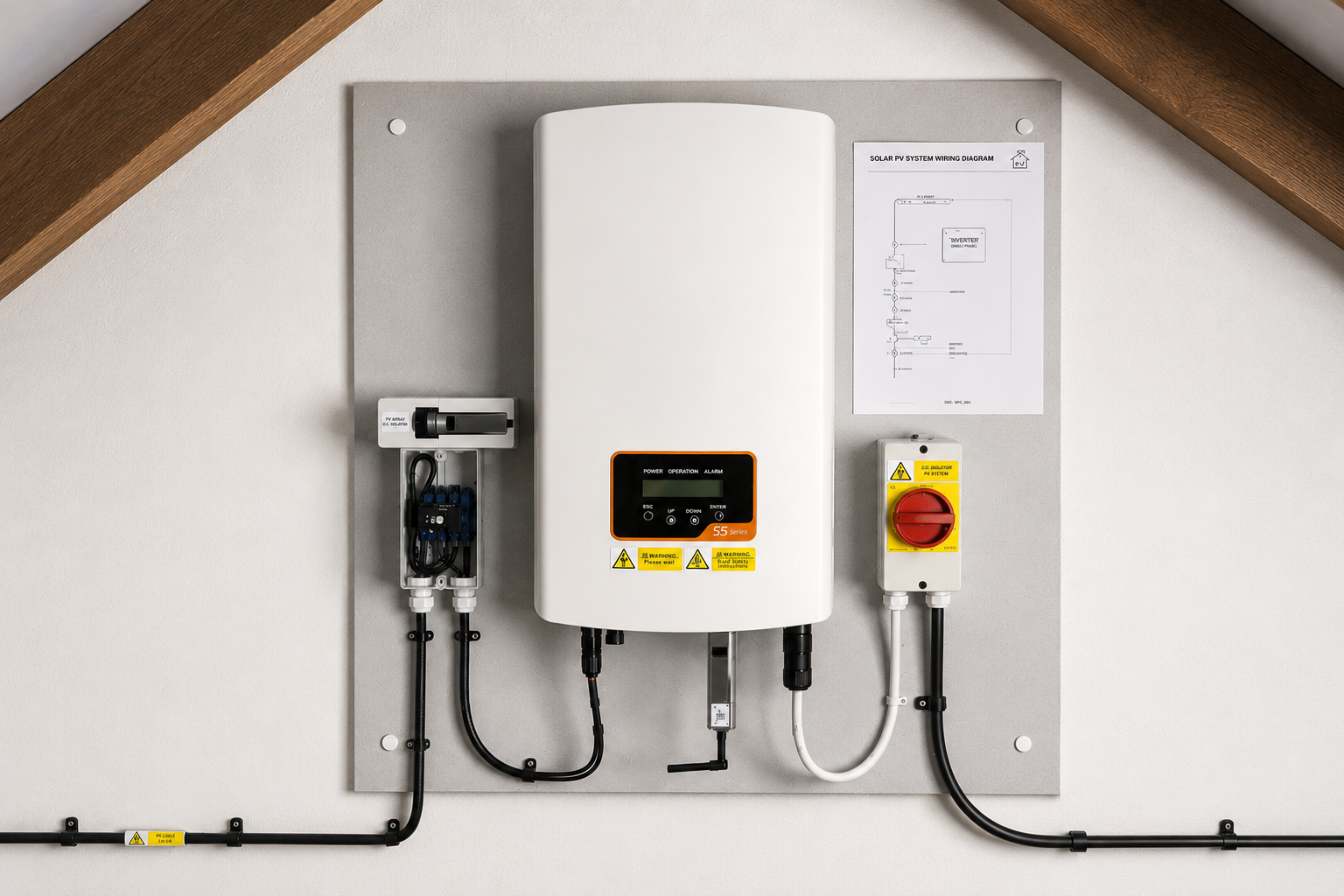

Solis Solar Inverter Review: Cheap but Any Good?
Solis is the budget king of UK inverters — made by the world’s third-largest manufacturer. Here’s what you get, what you give up, and the warranty catch to know about.
The short answer
Solis is the best-value reputable inverter you can put on a UK home in 2026. Made by Ginlong Technologies — the world’s third-largest inverter manufacturer and the #1 residential single-phase brand by shipments — it delivers solid mid-tier reliability at 10–20% less than mid-range rivals.
The trade-offs: a 5-year standard warranty (extends to 10 free, but only if registered — check yours), a monitoring app that’s fine rather than brilliant, and no panel-level shading control. For a straightforward roof and a sensible budget, it’s hard to beat. For shaded roofs or smart-tariff tinkerers, better options exist — our solar inverters guide maps the whole field.
What this review covers
If you’ve had solar quotes recently, there’s a good chance at least one specced a Solis. It’s one of the most-fitted inverters in the UK — practically every MCS installer has put dozens on roofs — and it usually appears in the cheapest quote on your pile. The obvious question: is cheap here a bargain or a corner cut?
This review gives you the honest picture — real 2026 prices, the warranty registration catch most owners miss, what the app is actually like to live with, and the common faults owners search for. If you’re new to what an inverter even does, start with our plain-English solar inverters explained guide, then come back.
Who makes Solis inverters?
Solis is the brand name of Ginlong Technologies, a stock-market-listed Chinese manufacturer founded in 2005. This isn’t a white-label box from an anonymous factory: Ginlong is the third-largest inverter manufacturer in the world with over 100GW shipped, and Wood Mackenzie ranks it the #1 residential single-phase inverter brand globally by shipments. It also runs a dedicated UK support office.
Scale matters for two practical reasons. First, reliability: Solis claims a 99.7% reliability rate and was the first inverter maker to complete independent PVEL reliability testing — and with millions of units in the field, systemic problems would be public knowledge by now. Second, longevity: a warranty is only as good as the company behind it, a lesson UK solar owners learned sharply when GivEnergy entered administration in April 2026. A profitable global #3 is about as safe as inverter warranties get.
The Solis S6 range explained
The current generation is the S6 series (replacing the older S5 and RHI units you’ll see on used-market listings). For UK homes there are two that matter:
Solis S6 string inverters
Solar only · lowest costThe straightforward DC-to-AC workhorse. Dual MPPT inputs mean it can handle panels on two different roof faces (an east-west split, say) independently — useful on many UK semis. Fanless design means it runs silently. The right choice if you’re certain you’ll never add a battery — otherwise read on.
Solis S6 hybrid inverters (3.6–8kW)
Battery-ready · the one to getThe volume seller, in sizes from 3.6kW (the G98-friendly pick for a 4kW solar system) up to 8kW, with IP66-rated versions for outdoor mounting. The killer feature is open battery compatibility: it works with Pylontech, BYD, Dyness, Fox ESS and Solis’s own packs, so you can shop the battery market on price rather than being locked into one brand’s ecosystem. A Solis hybrid plus a Pylontech battery is consistently one of the cheapest routes to solar-plus-storage in the UK — more on pairings in our solar batteries guide.
Solis also makes three-phase and commercial units, but for a typical UK home the S6 hybrid is the one your quote will name.
Solis inverter prices in 2026
| Model | Typical installed price | Comparable rivals |
|---|---|---|
| S6 string (3.6–6kW) | £600–£1,200 | Growatt, GoodWe (similar); Fronius (+£300–500) |
| S6 hybrid (3.6–6kW) | £1,200–£1,800 | Sunsynk, SolaX (+£100–300); SolarEdge (+£600+) |
| Hybrid + ~5kWh battery (hardware) | £2,500–£3,500 | £1,000–£2,000 less than premium-brand bundles |
Context: the inverter is usually 8–15% of a whole system’s price, so on a ~£6,000 4kW install, choosing Solis over a premium brand saves roughly £300–£600 up front. Whether that’s the right saving to make depends on your roof — shading changes the answer completely, as we’ll get to. And if the quote pairs Solis with decent panels, you’re not compromising the parts that live outside — see which panel brands earn their keep in our best solar panels guide.
Warranty: 5 years — with a catch worth knowing
This is the section to read twice. Solis’s UK standard warranty is 5 years — noticeably shorter than Fronius (10) or Sungrow (10 as standard). But on most UK residential models it extends to 10 years free of charge if the inverter is registered after installation, with paid extensions available up to 20 years.
The registration catch
That free extension doesn’t happen automatically. If your installer skips the registration step, you’re sitting on a 5-year warranty and probably don’t know it. When your system is commissioned, ask your installer to confirm the Solis warranty registration in writing — it takes them minutes and doubles your cover. Existing Solis owners: dig out your serial number and check your registration today. This is exactly the kind of detail a good MCS installer handles unprompted — and a good test of whether you’re dealing with one.
Worth adding for realism: inverters are the hardest-working electronics in a solar system, and one replacement over a system’s 25-year life is normal whatever brand you choose. A registered 10-year Solis warranty covers the risky first decade — which is the window that matters.
SolisCloud app & the WiFi dongle
Monitoring runs through SolisCloud (app and web), connected via a small WiFi dongle that plugs into the inverter. For most owners it does the job well: daily/monthly generation, battery charge state, import/export flows, and alerting if something stops working. The platform has improved meaningfully over the past couple of years, including remote control of hybrid systems.
Where it lags the best: data depth and smart-tariff intelligence. Enthusiasts who want granular data or automated price-following on tariffs like Octopus Agile will find SolisCloud basic — Solis supports simple time-of-use scheduling (e.g. charge the battery overnight in a set window) but not native Agile-style optimisation, and it’s not on the Intelligent Octopus Flux approved list, so peak-window exporting has to be timed manually. Home Assistant integration exists but with thinner community support than some rivals. If squeezing every penny from a smart tariff is your hobby, that matters; if you just want to glance at an app and see green numbers, it doesn’t.
Common Solis faults (and what they actually mean)
Search data tells us what Solis owners worry about, so let’s cover it honestly — noting that these are the same categories of fault every string/hybrid brand logs:
- “Inverter not exporting” — usually not a fault at all. Common causes: an export limit set during commissioning (sometimes required by your network operator), the battery absorbing generation before anything exports, or a smart-meter/tariff issue rather than the inverter. Check SolisCloud’s flow diagram before panicking.
- OV-BUS / over-voltage faults — the inverter shutting down to protect itself because grid voltage at your property is running high. Ironically this is usually the local grid’s issue (common on streets with lots of solar), not the Solis. Persistent cases: your installer can log it with the network operator, who may adjust the local transformer.
- App showing offline / no data — nine times out of ten it’s the WiFi dongle dropping connection after a router change or outage. The system keeps generating regardless; re-pair the dongle and history backfills.
- Genuine hardware failure — happens to a small percentage of any brand’s units, which is what the warranty is for. This is where that registration step pays for itself, and why using an MCS-certified installer who’ll still answer the phone matters more than the badge on the box.
Solis vs rivals: where it wins and loses
| If you want… | Best pick | Why |
|---|---|---|
| Lowest cost from a safe brand | Solis | 10–20% under mid-range rivals, global #3 maker |
| Battery brand freedom | Solis | Pylontech, BYD, Dyness, Fox ESS all work |
| Longest no-fuss warranty | Sungrow / Fronius | 10 years standard, no registration step |
| Shaded or complex roof | SolarEdge / Enphase | Panel-level optimisation Solis can’t match |
| Smart-tariff automation | Sunsynk | Deeper tariff intelligence & community tooling |
The shading point deserves emphasis because it’s the one that costs real money over 25 years: Solis is a string-architecture inverter, so shade on one panel drags down its whole string. On a clean roof that’s irrelevant; on a roof with chimneys, dormers or trees, panel-level systems win regardless of price — the full explanation is in our inverter types guide, and roof layout itself is covered in our panel sizes guide.
Solis inverters: pros & cons
✓ Pros
- Cheapest reputable inverter in the UK
- World #3 manufacturer — warranty backed by scale
- Open battery compatibility (shop on price)
- Huge UK install base — every installer knows them
- 99.7% claimed reliability, PVEL-tested, fanless
- Free 10-year warranty on registration
✗ Cons
- Only 5-year warranty if nobody registers it
- No panel-level shading mitigation
- SolisCloud is basic for data enthusiasts
- Limited native smart-tariff automation
- Not on the Intelligent Octopus Flux approved list
Frequently asked questions
Are Solis solar inverters any good?
Yes. Solis is made by Ginlong Technologies — the world’s third-largest inverter manufacturer and #1 residential single-phase brand by shipments — with a claimed 99.7% reliability rate and independent PVEL testing. In the UK it’s the best-value reputable inverter: solid mid-tier reliability at 10–20% less than mid-range rivals.
How much does a Solis inverter cost in the UK?
In 2026, a Solis string inverter typically costs £600–£1,200 installed, and an S6 hybrid (battery-ready) model £1,200–£1,800 installed — usually £200–£500 less than equivalent mid-range brands. On a full system, that’s a £300–£600 saving versus a premium inverter.
How long is the Solis warranty?
5 years as standard in the UK, extending to 10 years free on most residential models when the inverter is registered after installation. Confirm your installer completed the registration — unregistered units stay at 5 years. Paid extensions run up to 20 years.
What batteries work with Solis hybrid inverters?
A wide range — Pylontech, BYD, Dyness, Fox ESS and Solis’s own packs all pair with the S6 hybrids. That openness lets you shop the battery market on price rather than being locked in; see our solar batteries guide for how the pairings compare.
Why is my Solis inverter not exporting or showing a fault?
Most commonly: an export limit set at commissioning, the battery absorbing generation first, high local grid voltage (OV-BUS faults — usually the grid’s issue, not the inverter’s), or a WiFi dongle that’s dropped offline while the system generates normally. Persistent faults should go to your installer under warranty.
Is Solis the right inverter for a 4kW system?
Often, yes — a Solis 3.6kW hybrid pairs naturally with a 4kW solar system, stays within G98 grid rules for a quick install, and keeps the door open to a battery later. On a shaded roof, ask your installer to price a panel-level alternative alongside it.
The budget pick that isn’t a gamble
The bottom line: For an unshaded roof and a sensible budget, Solis is the smart money — world-class manufacturing at the lowest reputable price. Just make sure the warranty gets registered, and look elsewhere if shading or smart-tariff automation is your priority.
Get my free quotes →The verdict
Solis earns its place on so many UK quotes honestly: it’s the cheapest inverter you can buy from a genuinely world-class manufacturer, with open battery compatibility that keeps your storage options — and costs — flexible for years. The compromises are real but specific: register the warranty or you’re only covered for 5 years, accept a workmanlike app, and don’t put it on a shaded roof.
The best way to know if Solis is right for your home is to compare quotes — a good MCS-certified installer will price it against a panel-level alternative and tell you which your roof actually needs.
Important
Going Solar UK is an introduction service, not an installer. We don’t design, supply, or fit solar systems ourselves, and we have no commercial relationship with Solis or Ginlong Technologies. Specifications, prices and warranty terms in this review are indicative 2026 market details and change over time — always confirm current terms with your installer and the manufacturer before purchase. Brand names and trademarks belong to their respective owners.
We may receive a commission when we introduce you to an installer, at no cost to you. Any contract for work is directly between you and the installer.
Solis Solar Inverter Review: Cheap but Any Good?
Solis is the budget king of UK inverters — made by the world’s third-largest manufacturer. Here’s what you get, what you give up, and the warranty catch to know about.
The short answer
Solis is the best-value reputable inverter you can put on a UK home in 2026. Made by Ginlong Technologies — the world’s third-largest inverter manufacturer and the #1 residential single-phase brand by shipments — it delivers solid mid-tier reliability at 10–20% less than mid-range rivals.
The trade-offs: a 5-year standard warranty (extends to 10 free, but only if registered — check yours), a monitoring app that’s fine rather than brilliant, and no panel-level shading control. For a straightforward roof and a sensible budget, it’s hard to beat. For shaded roofs or smart-tariff tinkerers, better options exist — our solar inverters guide maps the whole field.
What this review covers
If you’ve had solar quotes recently, there’s a good chance at least one specced a Solis. It’s one of the most-fitted inverters in the UK — practically every MCS installer has put dozens on roofs — and it usually appears in the cheapest quote on your pile. The obvious question: is cheap here a bargain or a corner cut?
This review gives you the honest picture — real 2026 prices, the warranty registration catch most owners miss, what the app is actually like to live with, and the common faults owners search for. If you’re new to what an inverter even does, start with our plain-English solar inverters explained guide, then come back.
Who makes Solis inverters?
Solis is the brand name of Ginlong Technologies, a stock-market-listed Chinese manufacturer founded in 2005. This isn’t a white-label box from an anonymous factory: Ginlong is the third-largest inverter manufacturer in the world with over 100GW shipped, and Wood Mackenzie ranks it the #1 residential single-phase inverter brand globally by shipments. It also runs a dedicated UK support office.
Scale matters for two practical reasons. First, reliability: Solis claims a 99.7% reliability rate and was the first inverter maker to complete independent PVEL reliability testing — and with millions of units in the field, systemic problems would be public knowledge by now. Second, longevity: a warranty is only as good as the company behind it, a lesson UK solar owners learned sharply when GivEnergy entered administration in April 2026. A profitable global #3 is about as safe as inverter warranties get.
The Solis S6 range explained
The current generation is the S6 series (replacing the older S5 and RHI units you’ll see on used-market listings). For UK homes there are two that matter:
Solis S6 string inverters
Solar only · lowest costThe straightforward DC-to-AC workhorse. Dual MPPT inputs mean it can handle panels on two different roof faces (an east-west split, say) independently — useful on many UK semis. Fanless design means it runs silently. The right choice if you’re certain you’ll never add a battery — otherwise read on.
Solis S6 hybrid inverters (3.6–8kW)
Battery-ready · the one to getThe volume seller, in sizes from 3.6kW (the G98-friendly pick for a 4kW solar system) up to 8kW, with IP66-rated versions for outdoor mounting. The killer feature is open battery compatibility: it works with Pylontech, BYD, Dyness, Fox ESS and Solis’s own packs, so you can shop the battery market on price rather than being locked into one brand’s ecosystem. A Solis hybrid plus a Pylontech battery is consistently one of the cheapest routes to solar-plus-storage in the UK — more on pairings in our solar batteries guide.
Solis also makes three-phase and commercial units, but for a typical UK home the S6 hybrid is the one your quote will name.
Solis inverter prices in 2026
| Model | Typical installed price | Comparable rivals |
|---|---|---|
| S6 string (3.6–6kW) | £600–£1,200 | Growatt, GoodWe (similar); Fronius (+£300–500) |
| S6 hybrid (3.6–6kW) | £1,200–£1,800 | Sunsynk, SolaX (+£100–300); SolarEdge (+£600+) |
| Hybrid + ~5kWh battery (hardware) | £2,500–£3,500 | £1,000–£2,000 less than premium-brand bundles |
Context: the inverter is usually 8–15% of a whole system’s price, so on a ~£6,000 4kW install, choosing Solis over a premium brand saves roughly £300–£600 up front. Whether that’s the right saving to make depends on your roof — shading changes the answer completely, as we’ll get to. And if the quote pairs Solis with decent panels, you’re not compromising the parts that live outside — see which panel brands earn their keep in our best solar panels guide.
Warranty: 5 years — with a catch worth knowing
This is the section to read twice. Solis’s UK standard warranty is 5 years — noticeably shorter than Fronius (10) or Sungrow (10 as standard). But on most UK residential models it extends to 10 years free of charge if the inverter is registered after installation, with paid extensions available up to 20 years.
The registration catch
That free extension doesn’t happen automatically. If your installer skips the registration step, you’re sitting on a 5-year warranty and probably don’t know it. When your system is commissioned, ask your installer to confirm the Solis warranty registration in writing — it takes them minutes and doubles your cover. Existing Solis owners: dig out your serial number and check your registration today. This is exactly the kind of detail a good MCS installer handles unprompted — and a good test of whether you’re dealing with one.
Worth adding for realism: inverters are the hardest-working electronics in a solar system, and one replacement over a system’s 25-year life is normal whatever brand you choose. A registered 10-year Solis warranty covers the risky first decade — which is the window that matters.
SolisCloud app & the WiFi dongle
Monitoring runs through SolisCloud (app and web), connected via a small WiFi dongle that plugs into the inverter. For most owners it does the job well: daily/monthly generation, battery charge state, import/export flows, and alerting if something stops working. The platform has improved meaningfully over the past couple of years, including remote control of hybrid systems.
Where it lags the best: data depth and smart-tariff intelligence. Enthusiasts who want granular data or automated price-following on tariffs like Octopus Agile will find SolisCloud basic — Solis supports simple time-of-use scheduling (e.g. charge the battery overnight in a set window) but not native Agile-style optimisation, and it’s not on the Intelligent Octopus Flux approved list, so peak-window exporting has to be timed manually. Home Assistant integration exists but with thinner community support than some rivals. If squeezing every penny from a smart tariff is your hobby, that matters; if you just want to glance at an app and see green numbers, it doesn’t.
Common Solis faults (and what they actually mean)
Search data tells us what Solis owners worry about, so let’s cover it honestly — noting that these are the same categories of fault every string/hybrid brand logs:
- “Inverter not exporting” — usually not a fault at all. Common causes: an export limit set during commissioning (sometimes required by your network operator), the battery absorbing generation before anything exports, or a smart-meter/tariff issue rather than the inverter. Check SolisCloud’s flow diagram before panicking.
- OV-BUS / over-voltage faults — the inverter shutting down to protect itself because grid voltage at your property is running high. Ironically this is usually the local grid’s issue (common on streets with lots of solar), not the Solis. Persistent cases: your installer can log it with the network operator, who may adjust the local transformer.
- App showing offline / no data — nine times out of ten it’s the WiFi dongle dropping connection after a router change or outage. The system keeps generating regardless; re-pair the dongle and history backfills.
- Genuine hardware failure — happens to a small percentage of any brand’s units, which is what the warranty is for. This is where that registration step pays for itself, and why using an MCS-certified installer who’ll still answer the phone matters more than the badge on the box.
Solis vs rivals: where it wins and loses
| If you want… | Best pick | Why |
|---|---|---|
| Lowest cost from a safe brand | Solis | 10–20% under mid-range rivals, global #3 maker |
| Battery brand freedom | Solis | Pylontech, BYD, Dyness, Fox ESS all work |
| Longest no-fuss warranty | Sungrow / Fronius | 10 years standard, no registration step |
| Shaded or complex roof | SolarEdge / Enphase | Panel-level optimisation Solis can’t match |
| Smart-tariff automation | Sunsynk | Deeper tariff intelligence & community tooling |
The shading point deserves emphasis because it’s the one that costs real money over 25 years: Solis is a string-architecture inverter, so shade on one panel drags down its whole string. On a clean roof that’s irrelevant; on a roof with chimneys, dormers or trees, panel-level systems win regardless of price — the full explanation is in our inverter types guide, and roof layout itself is covered in our panel sizes guide.
Solis inverters: pros & cons
✓ Pros
- Cheapest reputable inverter in the UK
- World #3 manufacturer — warranty backed by scale
- Open battery compatibility (shop on price)
- Huge UK install base — every installer knows them
- 99.7% claimed reliability, PVEL-tested, fanless
- Free 10-year warranty on registration
✗ Cons
- Only 5-year warranty if nobody registers it
- No panel-level shading mitigation
- SolisCloud is basic for data enthusiasts
- Limited native smart-tariff automation
- Not on the Intelligent Octopus Flux approved list
Frequently asked questions
Are Solis solar inverters any good?
Yes. Solis is made by Ginlong Technologies — the world’s third-largest inverter manufacturer and #1 residential single-phase brand by shipments — with a claimed 99.7% reliability rate and independent PVEL testing. In the UK it’s the best-value reputable inverter: solid mid-tier reliability at 10–20% less than mid-range rivals.
How much does a Solis inverter cost in the UK?
In 2026, a Solis string inverter typically costs £600–£1,200 installed, and an S6 hybrid (battery-ready) model £1,200–£1,800 installed — usually £200–£500 less than equivalent mid-range brands. On a full system, that’s a £300–£600 saving versus a premium inverter.
How long is the Solis warranty?
5 years as standard in the UK, extending to 10 years free on most residential models when the inverter is registered after installation. Confirm your installer completed the registration — unregistered units stay at 5 years. Paid extensions run up to 20 years.
What batteries work with Solis hybrid inverters?
A wide range — Pylontech, BYD, Dyness, Fox ESS and Solis’s own packs all pair with the S6 hybrids. That openness lets you shop the battery market on price rather than being locked in; see our solar batteries guide for how the pairings compare.
Why is my Solis inverter not exporting or showing a fault?
Most commonly: an export limit set at commissioning, the battery absorbing generation first, high local grid voltage (OV-BUS faults — usually the grid’s issue, not the inverter’s), or a WiFi dongle that’s dropped offline while the system generates normally. Persistent faults should go to your installer under warranty.
Is Solis the right inverter for a 4kW system?
Often, yes — a Solis 3.6kW hybrid pairs naturally with a 4kW solar system, stays within G98 grid rules for a quick install, and keeps the door open to a battery later. On a shaded roof, ask your installer to price a panel-level alternative alongside it.
The budget pick that isn’t a gamble
The bottom line: For an unshaded roof and a sensible budget, Solis is the smart money — world-class manufacturing at the lowest reputable price. Just make sure the warranty gets registered, and look elsewhere if shading or smart-tariff automation is your priority.
Get my free quotes →The verdict
Solis earns its place on so many UK quotes honestly: it’s the cheapest inverter you can buy from a genuinely world-class manufacturer, with open battery compatibility that keeps your storage options — and costs — flexible for years. The compromises are real but specific: register the warranty or you’re only covered for 5 years, accept a workmanlike app, and don’t put it on a shaded roof.
The best way to know if Solis is right for your home is to compare quotes — a good MCS-certified installer will price it against a panel-level alternative and tell you which your roof actually needs.
Important
Going Solar UK is an introduction service, not an installer. We don’t design, supply, or fit solar systems ourselves, and we have no commercial relationship with Solis or Ginlong Technologies. Specifications, prices and warranty terms in this review are indicative 2026 market details and change over time — always confirm current terms with your installer and the manufacturer before purchase. Brand names and trademarks belong to their respective owners.
We may receive a commission when we introduce you to an installer, at no cost to you. Any contract for work is directly between you and the installer.