


Integrated (In-Roof) Solar Panels: Worth It?
In-roof panels sit flush within the roof for a sleek, rail-free look — popular on new builds and in conservation areas. But they cost more and generate slightly less. Here’s the honest in-roof vs on-roof verdict.
The short answer
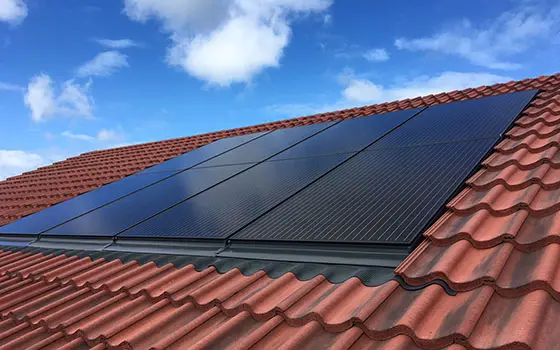
Integrated (in-roof) solar panels sit flush within the roof — sleeker than standard on-roof panels, but they cost more and generate slightly less. Instead of sitting on rails above your tiles, the tiles are removed across the array and the panels set into weatherproof trays that become part of the roof covering — giving a clean, rail-free finish with no visible mounting. They use the same panel technology as on-roof; the difference is purely how they’re mounted and how they look.
The trade-offs: in-roof costs ~10–20% more (~£6,500–£9,500 for a 4kW system, about £1,000 above on-roof), runs slightly less efficiently (less airflow underneath), and is harder to maintain. But there are three situations where it genuinely wins: new builds and re-roofs (where the trays offset tiles you’d buy anyway, flipping the cost to neutral or cheaper), conservation areas and listed buildings (where flush is often the only install that gets planning approval), and where looks and property value matter most. For most retrofits on a sound roof, standard on-roof is the better-value choice. Full comparison, costs, and where solar tiles fit, below.
What this guide covers
Standard solar panels do a brilliant job, but there’s no getting around the fact that, mounted on rails above the tiles, they stand proud of the roof and aren’t to everyone’s taste. Integrated in-roof panels are the answer to that — a flush, built-in look — and increasingly the default on new builds and in heritage areas. This guide is the honest comparison: what you gain, what it costs, and whether it’s worth it for your home.
What integrated (in-roof) solar actually is
Integrated solar — also called in-roof or roof-integrated solar — sits within the roofline rather than on top of it. In a standard on-roof installation (the most common type in the UK), panels are mounted on brackets and rails fixed above your existing tiles, standing a few centimetres proud of the roof. With in-roof, the tiles or slates are removed across the array area and the panels are set into weatherproof trays that become part of the roof covering — so the panels sit flush with the surrounding tiles, sealed into a flashing kit, with no visible rails, no gap and no “step”. From street level, a well-done in-roof array can look almost like a dark roof-window feature rather than a solar installation. Crucially, the panels themselves are usually identical: most installers fit the same N-type monocrystalline modules either way (the sleek all-black panels people like for their looks work in-roof too). The difference between in-roof and on-roof is mechanical — the mounting and the look — not the cell technology generating your power. And one clarification worth making early: integrated panels are not the same as solar tiles (like a Tesla Solar Roof), which are a different, pricier product covered below.
Cost vs on-roof — and the new-build flip
| 4kW system | On-roof | In-roof |
|---|---|---|
| Without battery | ~£7,000 | ~£8,000 |
| With battery | ~£8,500 | ~£9,700 |
| Typical premium | — | ~10–20% (£1,000) |
| New build / re-roof | Standard cost | Cost-neutral or cheaper* |
*Trays offset the tiles you’d otherwise buy over that roof area.
In-roof solar typically costs £6,500–£9,500 installed for a 4kW system — roughly 10–20% more than on-roof (about £1,000 extra), because removing roof covering, fitting weatherproof trays and coordinating roofers with solar installers all add labour. But the maths flips on a new build or re-roof, and this is the key nuance: because the integrated trays replace the tiles you’d otherwise buy over that area, in-roof becomes cost-neutral or even cheaper in those situations — you’re offsetting roofing materials you’d have paid for anyway. That’s why in-roof “makes most sense during roof work”. On brands: UK installers commonly fit GSE Integration (typically the most affordable, with ~1 million European installs), Viridian Clearline Fusion (a premium UK-made framed system favoured for conservation work), Marley SolarTile and Wienerberger — but roof complexity moves the price far more than brand choice does. As always, get a quote for your specific roof (and note that unusual or slate roofs, and non-standard roof types, can affect which mounting suits best).
The efficiency trade-off
In-roof panels are slightly less efficient than on-roof — but only slightly, and it’s worth understanding why. Because integrated panels sit flush within the roof rather than raised on rails, there’s less air circulating underneath them. Solar panels lose a little efficiency as they heat up, and the reduced airflow means in-roof panels run marginally warmer than on-roof ones (which have a ventilation gap behind them), costing a few percent of output over a year — a minor reduction, not a dramatic one. For most households it’s easily outweighed by other factors if in-roof is the right choice for them. But it does mean that, purely on generation-per-pound, on-roof has a slight edge: it costs less and generates a touch more, so it typically delivers a faster payback and better return. If maximising generation and financial return is your single priority, on-roof wins narrowly; if appearance, property value or planning matter more, the small efficiency trade-off of in-roof is usually a price worth paying. Both, fitted by an MCS-certified installer, are fully weatherproof and reliable — the gap is real but modest.
In-roof vs on-roof: pros & cons
✓ In-roof strengths
- Sleek, flush, rail-free finish — best kerb appeal
- Often the only option approved in conservation/listed areas
- Cost-neutral or cheaper on new builds & re-roofs
- Can add more to property value
- Less wind-catch; tidy integration
✗ In-roof trade-offs
- ~10–20% more than on-roof (on a retrofit)
- Slightly less efficient (runs hotter, less airflow)
- Harder to maintain / repair individual panels
- More complex install (roofer + solar coordination)
- More roof-fabric disturbance on a retrofit
The honest summary: on-roof is cheaper, quicker, slightly more efficient and easier to maintain — the sensible default for most retrofits. In-roof is sleeker, planning-friendly and cost-effective during roof work — the specialist choice that wins in specific situations.
Conservation areas & listed buildings: in-roof’s strongest case
In heritage areas, flush in-roof is often the only install that gets approved
This is where in-roof solar genuinely comes into its own. In conservation areas, zones with Article 4 directions, and on listed buildings, planning authorities are frequently unwilling to approve standard on-roof panels that stand proud of the roofline and are visible from the street — they’re judged to harm the building’s or area’s character. Flush, integrated in-roof panels sit within the roof plane and are far less visually intrusive, so they’re much more likely to gain consent — and in many heritage cases, a flush installation is effectively a condition of approval. That makes in-roof the go-to for period properties, homes in conservation areas (think the Georgian terraces of Bristol’s Clifton, or homes within a National Landscape/AONB), and listed buildings where the owner wants solar but must satisfy planning. The premium framed systems like Viridian Clearline Fusion are often specified here, because conservation officers recognise their neat, purpose-designed look. Two caveats: listed buildings always need listed building consent regardless of mounting type, and even flush installs may need permission in the most sensitive spots — so always check with your local planning authority (or have your installer do it) first. But the general rule holds: if you’ve been told on-roof solar won’t be approved where you live, integrated in-roof panels are very often the answer that will.
In-roof panels vs solar tiles (they’re not the same)
A common and important confusion worth clearing up. Integrated in-roof panels are standard-sized solar panels set flush into the roof within trays — they cover a section of the roof, surrounded by your normal tiles. Solar tiles (or solar slates, marketed most famously as the Tesla Solar Roof) are entirely different: small individual units, each roughly the size of a roof tile, that replace your tiles one-for-one to form the whole roof — so the entire roof becomes the solar system and looks like a normal (if sleek) tiled roof rather than a panel array. The differences matter: solar tiles offer the most discreet appearance of all (ideal for the most heritage-sensitive or design-led properties) but are considerably more expensive (often two to three times the cost of integrated panels or more), usually less efficient per square metre, slower to install, and a more niche product with fewer installers. Integrated in-roof panels are the well-established middle ground: much sleeker than on-roof, far cheaper than solar tiles, using standard high-efficiency panels. For most people wanting a flush look, integrated panels are the sensible choice; solar tiles make sense mainly for whole-roof replacements on premium or exceptionally sensitive properties where budget is secondary.
When each one wins
Choose in-roof (integrated) if: you’re building new or re-roofing (the cost flips favourable and it integrates seamlessly); you’re in a conservation area, Article 4 zone or listed building where flush is required for approval; or aesthetics, kerb appeal and property value genuinely matter to you and you’ll pay a modest premium. Choose standard on-roof if: you’re retrofitting to an existing sound roof (the most common case), you want the best value and fastest payback, you want to maximise generation, or you value easy maintenance. For the large majority of UK homes — a retrofit onto a decent existing roof outside a heritage area — on-roof is the sensible, cost-effective choice, delivering slightly better returns for less money. In-roof is the specialist option that wins clearly in its own situations: during roof work, in heritage settings, or where looks matter most. The best way to decide is to get both quoted side by side — many installers will price on-roof and in-roof together — and weigh the extra cost against how much the flush finish and any planning requirements matter for your home.
Frequently asked questions
What are integrated (in-roof) solar panels?
Panels set flush within the roof — the tiles are removed across the array and the panels sit in weatherproof trays that become part of the roof covering, so there are no visible rails or gap. They use the same panels as on-roof; only the mounting and look differ. They’re not the same as solar tiles.
How much do they cost vs on-roof?
~£6,500–£9,500 for a 4kW in-roof system — roughly 10–20% (about £1,000) more than on-roof (~£7,000). But on a new build or re-roof the trays offset the tiles you’d buy anyway, making in-roof cost-neutral or cheaper. Roof complexity affects price more than tray brand.
Are integrated panels less efficient?
Slightly — sitting flush means less airflow underneath, so they run a little hotter and lose a few percent of output over a year. Modest, not dramatic. On generation-per-pound, on-roof has a slight edge (cheaper and a touch more output); in-roof trades that for looks and planning approval.
Are they better for conservation areas and listed buildings?
Often they’re the only option approved. Conservation areas, Article 4 zones and listed buildings frequently refuse proud on-roof panels but accept flush in-roof, which sits within the roof plane. Listed buildings always need consent regardless — check with your planning authority first.
When should I choose in-roof over on-roof?
Three cases: new builds/re-roofs (cost flips favourable), conservation/listed properties (flush often required for approval), and where aesthetics/property value matter most. For most retrofits on a sound roof, on-roof is better value with a faster payback. Get both quoted side by side.
Are integrated panels the same as solar tiles?
No. Integrated panels are standard panels set flush into a section of roof. Solar tiles (e.g. Tesla Solar Roof) are small units replacing every tile to form the whole roof — the most discreet look, but often 2–3× the cost, less efficient per m², and more niche. Integrated panels are the sleeker-but-affordable middle ground.
On-roof for value; in-roof for new builds & heritage
The bottom line: Integrated in-roof solar sits flush in the roof for a sleek, rail-free look, but costs ~10–20% more than on-roof (£6,500–£9,500 for 4kW) and generates slightly less (less airflow = runs hotter). It’s genuinely worth it in three cases: new builds and re-roofs (where trays offset tiles, flipping the cost to neutral or cheaper), conservation areas and listed buildings (where flush is often the only approved install), and where aesthetics and property value matter most. For most retrofits on a sound roof, standard on-roof wins on value, efficiency and easy maintenance. Get both quoted side by side and decide on the numbers. Note: integrated panels aren’t solar tiles — those replace the whole roof and cost far more.
Get my free quotes →The verdict
Integrated in-roof solar solves a genuine problem — the bulky, rail-mounted look of standard panels — with a flush, built-in finish that’s genuinely handsome and, in the right setting, transformative for a home’s appearance. But it’s a specialist choice rather than a default. For a straightforward retrofit onto a sound existing roof, standard on-roof panels remain the sensible pick for most people: they cost less, generate slightly more, are easier to maintain, and pay back faster. The flush look of in-roof is lovely, but on its own it rarely justifies the ~£1,000 premium for a typical home.
Where in-roof genuinely earns its place is clear and worth acting on: on a new build or re-roof (where the cost flips in its favour and it integrates seamlessly), and in conservation areas or on listed buildings (where a flush installation is often the only one planning will approve — making in-roof not just the prettier option but the only route to solar at all). If either of those describes you, in-roof is very likely the right call. The way to be sure is to have both quoted for your specific roof: a couple of free, no-obligation quotes from MCS-certified installers will show you the real cost difference, the planning position for your property, and which mounting genuinely suits your home and plans.
Important
Going Solar UK is an introduction service, not an installer. This guide is general 2026 information: costs, the efficiency difference, tray-system options and planning requirements vary by property, roof type, location and installer – the figures here are typical estimates, not guarantees. Planning treatment of solar in conservation areas and on listed buildings varies by local authority and individual property; always confirm the position with your local planning authority before committing. Obtain professional surveys and itemised quotes for both in-roof and on-roof options before deciding.
We may receive a commission when we introduce you to an installer, at no cost to you. Any contract for work is directly between you and the installer.